Featured

Data scientists at UW feature strongly in a recent article on the AAAS publication Science Careers. Sarah Loebman, Bill Howe, Ed Lazowska, Jevin West, and Andrew White share the experiences they've had on the road to becoming handy wranglers of massive data sets.

Astronomy Simulations

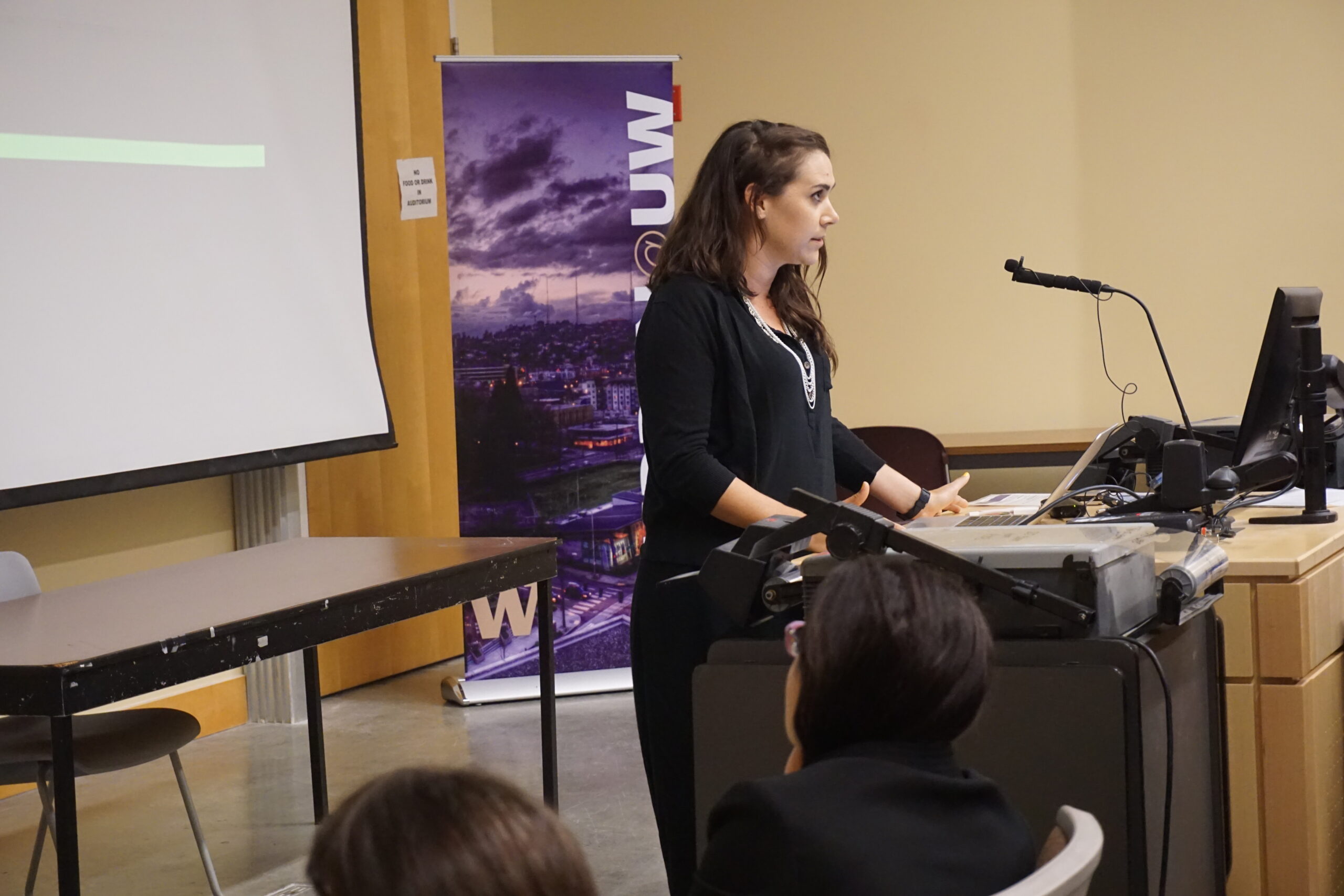
Sarah Loebman, a graduate student at the UW, studies the Milky Way galaxy to find out how it arrived at its present structure. She works with two groups in the astronomy department there, one that surveys the night skies and another that runs high-resolution simulations. Both contend with huge volumes of data. "Earlier in my career, I spent a good part of the day just loading data into my computer," she says.

When a physics colleague won a NASA grant to explore how database technology could be used in astronomy, she collaborated with him and with faculty from the computer science department, to see what could be done with her unwieldy data sets. The first thing she did was sign up for a graduate-level class on database management systems. It changed the way she saw her work: "Using a database shifted my focus to look beyond just one moment in time in a simulation," she says. Soon she was helping other colleagues deal with their data and streamline their work.

The New York Times discusses the tremendous demand for data science professionals, and the sources of these professionals. (Mostly computer science programs, of course …)

14bigdata-pie-popup


Bill Howe of UW CSE and the UW eScience Institute gets the last word in the article:

“The question, said Bill Howe, who teaches data science at the University of Washington, is whether it is even possible to instill in a single person all the skills needed, from statistics to predictive modeling to business strategy. The university’s offerings range from a free online course on Coursera to a nine-month certificate program to a Ph.D. track in Big Data.

A vast amount of scientific knowledge is inaccessible to the scientific community due to the lack of computational resources or tools for small laboratories to share or analyze experimental results. With a new grant from the National Science Foundation, the eScience Institute will collaborate with leading institutions to look for ways that software can bring this data out of hiding, revealing untapped value in the “long tail” of scientific research.

The two-year, $500,000 planning grant enables investigators at the Computation Institute (a joint initiative between the University of Chicago and Argonne National Laboratory), University of California, Los Angeles, University of Arizona, University of Washington and University of Southern California to lay the groundwork for a proposed Institute for Empowering Long Tail Research as part of the NSF’s Scientific Software Innovation Institutes program. Researchers will engage with scientists from fields such as biodiversity, economics and metagenomics to determine the optimal solutions for the increasingly challenging data and computational demands upon smaller laboratories.

Hyak, the University of Washington's high-performance computing facility, is featured in the most recent issue of Perspectives, the newsletter of the College of Arts and Sciences.


Read the full story here.

The University of Washington and the Pacific Northwest National Laboratory have announced the creation of the Northwest Institute for Advanced Computing, a joint institute based at the UW that will foster collaborative computing research between the two institutions.

"The expanded partnership between UW and PNNL will create tremendous new opportunities for both organizations,” said Ed Lazowska, professor of computer science and engineering. “Big data is transforming the process of discovery in all fields. UW and PNNL have significant and complementary strengths."

Read the UW press release here. Read the PNNL press release here.

Popular

Learn how the University of Washington is expanding data-driven research.
Shared high performance computing hosted by the University of Washington.
Learn how the structured query language and SQLShare can help your research.
Other organizations involved in data-driven discovery.
Faculty and staff engaged in eScience research and discovery.